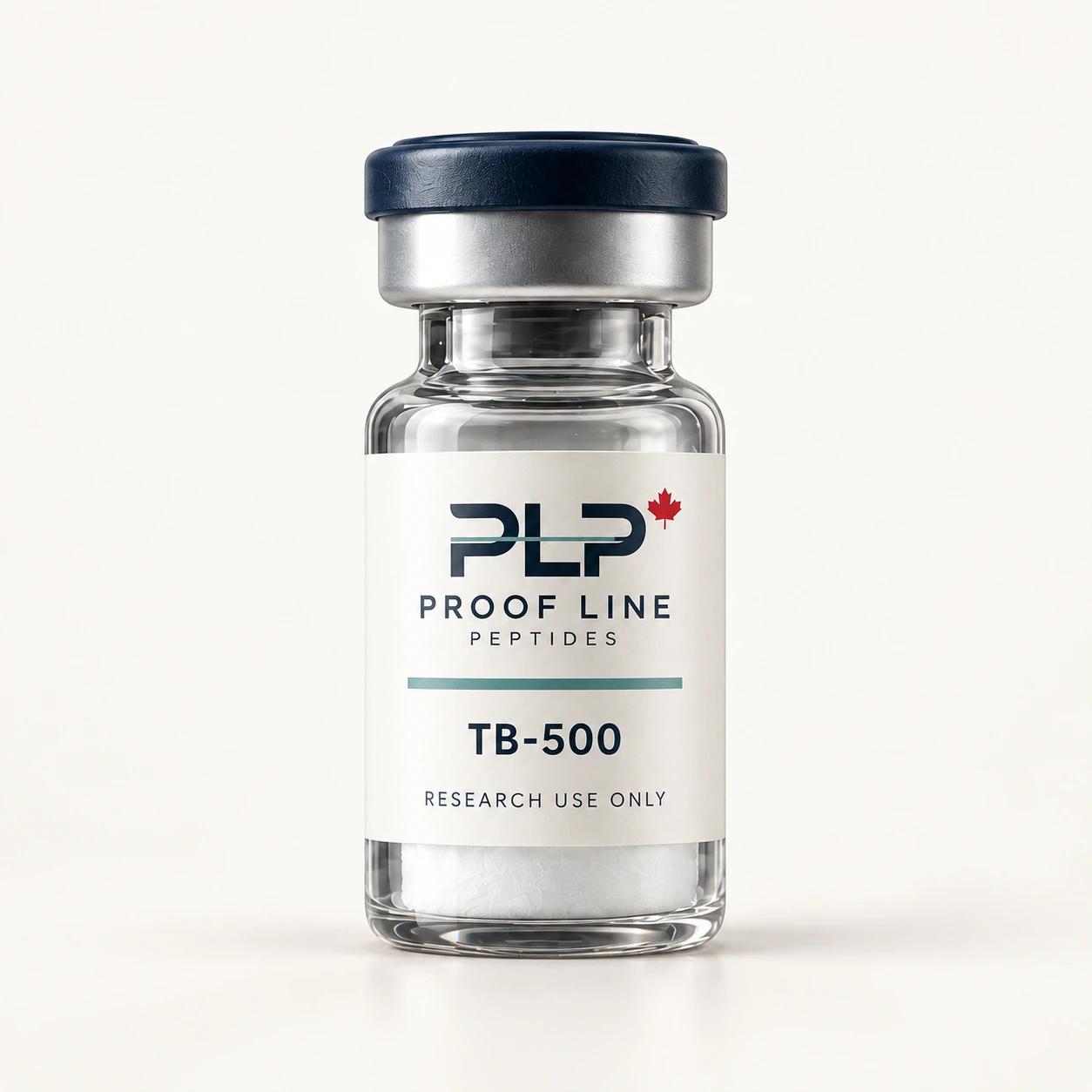
TB-500 is a research material discussed alongside thymosin beta-4 biology. The cited literature studied thymosin beta-4 and a synthetic peptide containing its actin-binding domain in mouse wound models — which is animal evidence, and not proof that a TB-500 vial is full-length thymosin beta-4.
Two related but distinct identities
Thymosin beta-4 is a naturally occurring protein studied for its actin-binding activity. A shorter synthetic peptide containing its actin-binding domain, the sequence LKKTETQ, has been studied separately. A product name alone does not tell you which of these a vial contains, so identity should be confirmed from supplier documentation rather than inferred.
What researchers have studied
Published work reported that thymosin beta-4 and the synthetic actin-binding-domain peptide promoted dermal wound repair in diabetic (db/db) and aged mice — models chosen because healing is impaired in them. [Philp et al., 2003]
The reason those models are used is also the reason to read the result narrowly: they are deliberately simplified stand-ins for impaired healing. A positive result in such a model supports continued investigation; it does not describe a clinical outcome.
What analytical chemistry adds to the identity question
Independent laboratories have examined materials sold under the TB-500 name. In one characterization, chromatography and mass spectrometry identified the N-acetylated thymosin beta-4 (17-23) fragment — Ac-LKKTETQ — in an analyzed TB-500 product rather than the full-length protein. [Drug Testing and Analysis, 2012]
A separate analytical study developed detection of that same fragment and its metabolites in equine samples, work aimed at anti-doping screening rather than at studying any healing effect. Together these papers reinforce a narrow point: the name TB-500 has been attached to at least one short fragment, so a label alone does not establish which molecular form a particular vial contains. [Journal of Chromatography A, 2012]
These findings describe what specific analyzed samples contained. They do not establish the composition of any other supplier's product, including this one — that remains a per-lot documentation question.
What remains unknown at the product level
| Exact sequence | Confirm from supplier documentation; do not infer it from a trade-style name. |
|---|---|
| Full-length identity | Whether a TB-500 vial is full-length thymosin beta-4 is a supplier-specified question. |
| Identifiers | Registry numbers and molecular details should come from the documentation, not from assumption. |
How to compare TB-500 listings
- Ask what molecule the documentation names, not what the marketing name implies.
- Check that any analytical report identifies the same lot as the vial.
- Separate identity results from purity results; they answer different questions.
- Keep animal-model findings labelled as animal-model findings in your notes.
Why identity discipline matters here
When a name can plausibly refer to more than one molecular form, quality attributes such as identity confirmation become the practical centre of the purchase decision. Technical quality overviews treat identity, purity and content as separate attributes, each with its own method — a useful framing when comparing suppliers. [GenScript peptide quality overview]
“TB-500” compared with full-length thymosin beta-4
Short answer: they are not interchangeable terms. Thymosin beta-4 is a full-length 43-amino-acid protein described in the research literature. “TB-500” is a commercial product name, and analyses of tested products sold under it reported the short N-acetylated Ac-LKKTETQ fragment instead of the full-length protein. [Drug Testing and Analysis, 2012]
| Thymosin beta-4 (Tβ4) | A named full-length protein studied in laboratory and animal research. Papers about Tβ4 are about that molecule. |
|---|---|
| “TB-500” as a listing name | A trade name. It does not encode a sequence, a length, or a modification, so it cannot by itself establish which of the two a vial holds. |
| What the analytical work showed | Laboratory analysis of tested products found the short acetylated fragment, not full-length Tβ4. This was analytical chemistry and anti-doping / equine detection work — not a human efficacy study. |
| What it does not show | It does not establish the composition of any particular current product, including anything in this catalogue, and it does not show that either molecule treats anything in people. |
This is why a study about thymosin beta-4 cannot be carried over to a vial labelled TB-500 without a sequence statement. The exact sequence of the material described on this page is not asserted anywhere on this site: we have no lot-specific analytical report to cite, so we say so rather than choosing the more flattering reading of the name. [Journal of Chromatography A, 2012]