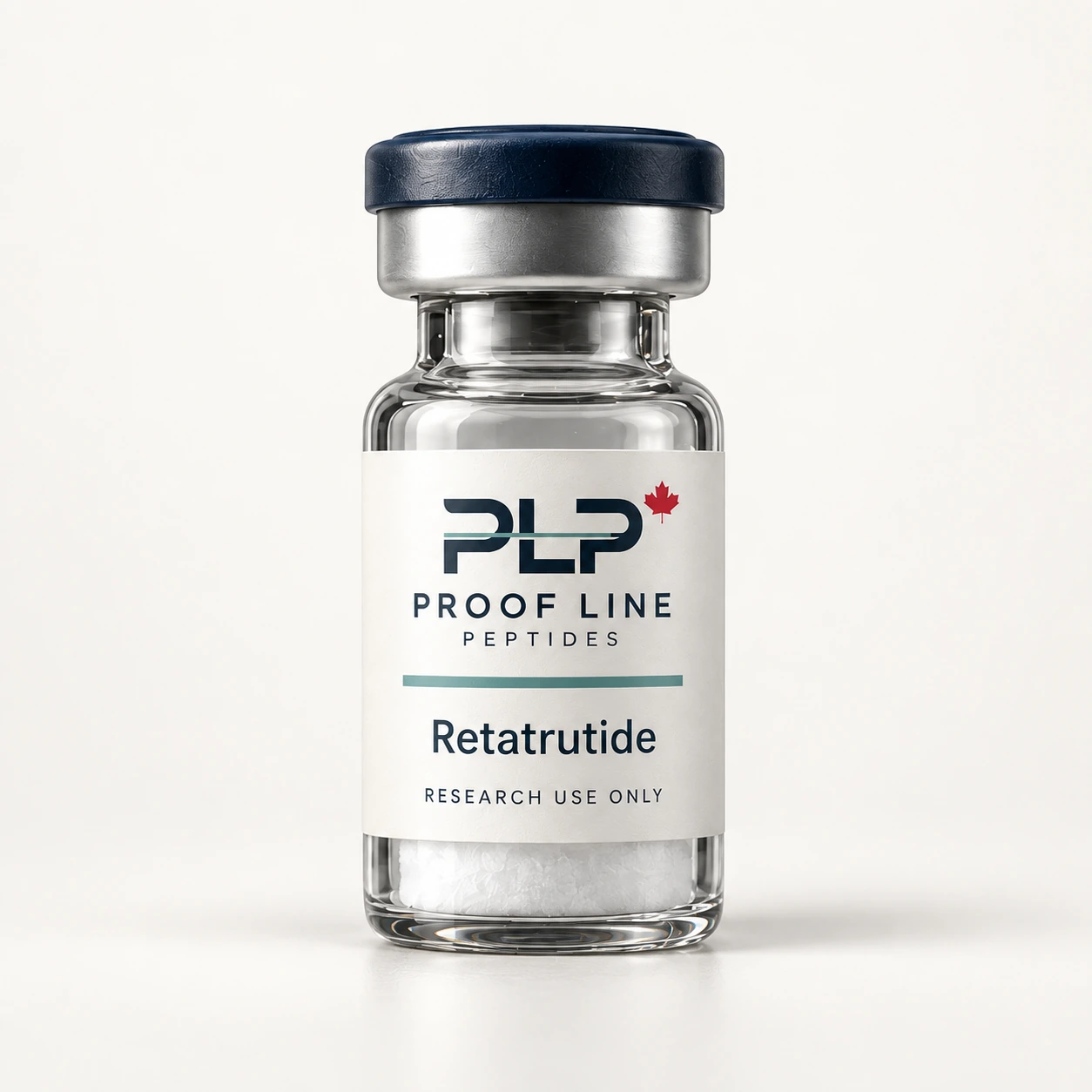
Retatrutide is described in published research as an agonist at three receptors: GLP-1, GIP and glucagon. The best-known report is a 2023 phase 2 randomized, placebo-controlled trial in 338 adults over 48 weeks. It is not a “GLP-3” compound, and it is not GLP-2. [Jastreboff et al., 2023]
What the compound is
It is an investigational multi-receptor peptide agonist studied in metabolic research. It activates GLP-1, GIP and glucagon receptors; receptor activity and clinical outcomes are separate questions. Invented generation-style names circulating in marketing copy do not correspond to any receptor.
What the trial reported
In that 48-week phase 2 trial, body-weight outcomes were lower in the study arms than with placebo. The report also described gastrointestinal adverse events and increases in heart rate. [Jastreboff et al., 2023]
Reading benefit and harm from the same report is the point of appraisal. A summary that keeps the weight result and drops the gastrointestinal events and heart-rate findings has changed the evidence, not condensed it.
What the evidence does not establish
| Current programme stage | The cited report is explicitly a 2023 phase 2 trial; that is its stage, not a statement about today. |
|---|---|
| Canadian authorization | Any authorization claim requires checking the specific current record in Health Canada’s Drug Product Database. |
| Product equivalence | A research vial is not the trial medicine; trials study a specific manufactured product. |
Checklist for retatrutide claims
- Confirm the receptor list: GLP-1, GIP and glucagon.
- Reject “GLP-3” and other invented target names outright.
- Quote the study stage and year as published.
- Check authorization questions in the official database, not in marketing text.
Where to verify status
Health Canada’s Drug Product Database is the reference for whether a specific drug product is authorized for sale in Canada. An ingredient-name match in that database says nothing about an unrelated research vial. [Health Canada Drug Product Database]
Reading a multi-receptor description without over-reading it
Short answer: “acts at three receptors” describes where a molecule binds, not how well it works. Retatrutide is reported to act at GLP-1, GIP and glucagon receptors; whether and how that translates into any outcome is a separate question answered by outcome data, not by the mechanism sentence. [Jastreboff et al., 2023]
| Mechanism claim | Which receptors a molecule is reported to act at. Supported by pharmacology work. |
|---|---|
| Outcome claim | What changed, in whom, compared with what, over how long. Supported only by trial results with a stated population, comparator and endpoint. |
| Status claim | Where a compound sits in development or regulation. Changes over time; a 2023 report cannot establish today's status. |
| Product claim | What a specific vial contains. Answered by lot-matched documentation, never by a published paper. |
A single-compound comparison against a GLP-1-only molecule therefore compares described receptor targets, nothing more. We do not describe one as better than another, and we do not state the current trial or approval status of this compound.