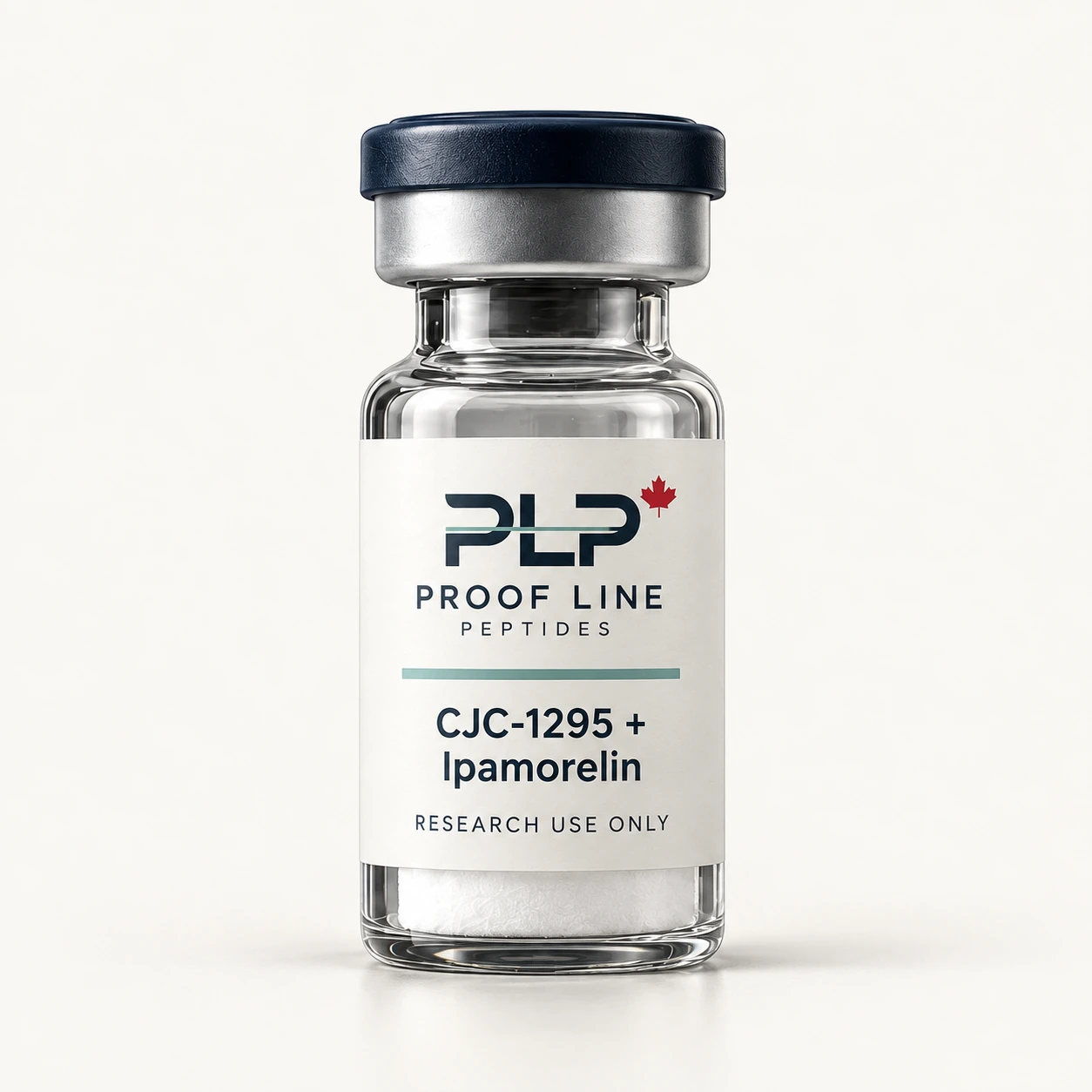
This listing names two research compounds that act through different mechanisms on the growth-hormone axis. The published studies examined them separately, so component evidence is all the cited literature supports — not a combined effect, and not a specific ratio.
Two distinct signals
CJC-1295 is discussed as a long-acting analogue of growth-hormone-releasing hormone. Two short randomized controlled studies in healthy adults reported prolonged stimulation of growth hormone and IGF-I secretion with long-acting CJC-1295 given alone. [Teichman et al., 2006]
Ipamorelin is a pentapeptide described as a selective growth hormone secretagogue, studied in cell preparations, rats and swine with receptor pharmacology resembling that of growth-hormone-releasing peptides. It is therefore a different entry point to the same axis, not a duplicate of the first. [Raun et al., 1998]
What the blend listing does not specify
| Component ratio | The catalogue lists a 10 mg blend. How that is divided between components is not stated, so it is unknown. |
|---|---|
| DAC status | Whether the CJC-1295 component is the DAC (long-acting) form or a non-DAC form is supplier-specified and not stated here. |
| Half-life figures | Published long-acting pharmacology cannot be quoted as a specification for this vial. |
What has not been shown
The cited studies do not demonstrate synergy between the two components, and they do not report sleep, muscle or anti-ageing outcomes. Claims of that kind would require trials designed around those endpoints in a defined population. [Teichman et al., 2006][Raun et al., 1998]
Checklist for blend comparisons
- Write down each component name exactly as listed.
- Mark ratio and molecular form as “not stated” unless documented.
- Keep each component’s literature attached to that component.
- Do not transfer a long-acting half-life figure onto an unspecified form.
CJC-1295 with and without DAC: a naming distinction, not a detail
Short answer: “CJC-1295” is used online for two different things — a GHRH analogue carrying a Drug Affinity Complex (DAC) that extends its persistence, and the same peptide backbone without that modification. The published long-acting pharmacokinetic work is about the DAC-bearing form and does not transfer to a non-DAC product. [Teichman et al., 2006]
| With DAC | The form studied in the published single-dose work on a long-acting GHRH analogue. Its reported persistence is a property of that modified molecule. |
|---|---|
| Without DAC (often written “mod GRF 1-29”) | The unmodified backbone. Persistence findings from the DAC literature are not evidence about it. |
| What a listing name settles | Nothing on its own. “CJC-1295” without a stated modification leaves the question open. |
| Which form this listing is | Unknown to us in writing. We do not have a supplier statement specifying DAC or non-DAC, so we do not claim either, and we do not apply the long-acting findings to this listing. |
Component evidence versus blend evidence
A blend adds a second gap. Published work on each component separately is evidence about that component at the doses and conditions studied. It is not evidence about a combination, and the ratio in a blend changes what is present. Where no ratio is documented, the honest statement is that the per-component quantities are unknown — not an estimate.